



Malaysia could be heading into its hottest year on record.
In February 2026, climate experts warned that there is a 60 to 70 per cent chance El Niño will develop in the second half of this year and carry over into 2027. Professor Emeritus Fredolin Tangang of Universiti Kebangsaan Malaysia said that if it does arrive, 2026 or 2027 could surpass 2024 as the warmest year ever recorded. MetMalaysia has already projected drier-than-normal conditions from February through July, with heat and fire risks rising across Peninsular Malaysia and Sarawak.
If you have been thinking about buying a new aircon, or replacing an old one, then one of the most important decisions is choosing the right horsepower (HP) for your room. Too low, and you might sweat through the night. Too high, and you will pay for cooling power you do not need. But, like Goldilocks, when you get it “just right”, your aircon will run efficiently, keep your room comfortable, and won’t push your TNB electricity bill into a higher tariff band.
Here is a quick guide to figure out what aircon size you need to buy for your room.
Table of Contents
Quick Reference: Aircon HP by Room Size
For most Malaysian homes with standard ceiling heights (9 to 10 feet), this table is all you need:
| Room Size (sq ft) | Recommended HP | Approximate BTU | Typical Room |
|---|---|---|---|
| Up to 150 | 1.0 HP | 9,000 BTU | Small bedroom, study room |
| 150 – 250 | 1.5 HP | 12,000 BTU | Standard bedroom, home office |
| 250 – 350 | 2.0 HP | 18,000 BTU | Master bedroom, large bedroom |
| 350 – 450 | 2.5 HP | 22,000 – 24,000 BTU | Large living room, dining area |
| 450 – 550 | 3.0 HP | 24,000 – 27,000 BTU | Open-plan living area, commercial space |
How to read this table: Measure your room’s length and width in feet, then multiply them. A room that is 12 feet by 10 feet = 120 sq ft, so a 1.0 HP aircon is a good fit.
This table assumes a room with normal insulation, no extreme sun exposure, and a ceiling height of about 10 feet or below. If your room has special conditions, keep reading.
Tip: Not sure what size your room is? Most Malaysian bedrooms in terrace houses are between 100 and 200 sq ft. A typical master bedroom is around 200 to 250 sq ft. Your living room is usually 250 to 400 sq ft depending on the house type.
What Do HP and BTU Actually Mean?
You will hear two terms thrown around when shopping for an aircon: HP and BTU.
HP (Horsepower) is how most Malaysians describe the “size” of an aircon. When someone says “I need a 1.5 HP aircon,” they are talking about its cooling power.
BTU (British Thermal Unit) is the more precise measurement. It tells you how much heat the aircon can remove from a room in one hour. A higher BTU means stronger cooling.
The rough conversion is: 1.0 HP ≈ 9,000 BTU/hr
But here is something worth knowing: two different “1.0 HP” models from different brands can have slightly different BTU ratings. One brand might rate their 1.0 HP unit at 9,000 BTU while another rates theirs at 9,600 BTU. So if you are comparing models, check the BTU number on the spec sheet rather than relying on the HP label alone.
If you are also weighing up inverter vs non-inverter aircons, an inverter unit will generally deliver more consistent cooling at the same HP rating because it adjusts the compressor speed instead of cycling on and off.
The Simple Formula (If You Want to Calculate It Yourself)
The rule of thumb used by most aircon contractors in Malaysia is:
Room area (sq ft) × 60 BTU = Cooling capacity needed
Then divide by 9,000 to get the HP.
Worked example: Your bedroom is 12 feet long and 15 feet wide.
- Floor area: 12 × 15 = 180 sq ft
- BTU needed: 180 × 60 = 10,800 BTU
- HP needed: 10,800 ÷ 9,000 = 1.2 HP
Since aircons come in fixed sizes, you would round up to 1.5 HP.
This formula assumes a standard ceiling height of about 10 feet, which covers most Malaysian homes. If your ceiling is higher than that, see the adjustments below.
When You Need to Size Up (Adjustment Factors)
The table and formula above work well for a “normal” room. But some rooms need extra cooling power. Here are the common situations:
High Ceilings (Above 10 Feet)
Taller ceilings mean more air volume to cool. For every extra foot above 10 feet, add 10% more BTU.
Example: A 200 sq ft room with a 13-foot ceiling would need 30% more BTU than normal.
- Base BTU: 200 × 60 = 12,000
- Adjusted: 12,000 × 1.3 = 15,600 BTU
- That pushes you from 1.5 HP to 2.0 HP.
West-Facing Rooms or Direct Afternoon Sun
In Malaysia, the afternoon sun hits hard from the west. If your room faces west, or has large windows getting direct sunlight for several hours, the walls and glass absorb and radiate heat into the room.
Recommendation: Go up one HP size from what the table suggests. A room that would normally need 1.0 HP should get a 1.5 HP unit instead.
This is especially important for corner houses (landed properties) and top-floor apartments where heat comes from both the walls and the roof. If you are in this situation, a well-maintained aircon that does not have to fight through dust and grime will make a real difference to how well it copes.
Large Windows or Floor-to-Ceiling Glass
Modern condos often feature floor-to-ceiling glass panels. Glass is a poor insulator compared to brick walls, so these rooms heat up faster than their floor area would suggest.
Recommendation: Add 10 to 15% more BTU, or go up one HP size if the glass covers a large portion of the wall.
More Than 2 People in the Room Regularly
Each person generates body heat. If the room regularly has more than two occupants (for example, a family TV room or a small home office with a few people), add about 600 BTU per extra person.
Kitchens
Cooking generates a lot of heat. If you are cooling an open-concept kitchen area, add an extra 4,000 BTU on top of the base calculation.
What Happens If You Choose the Wrong HP?
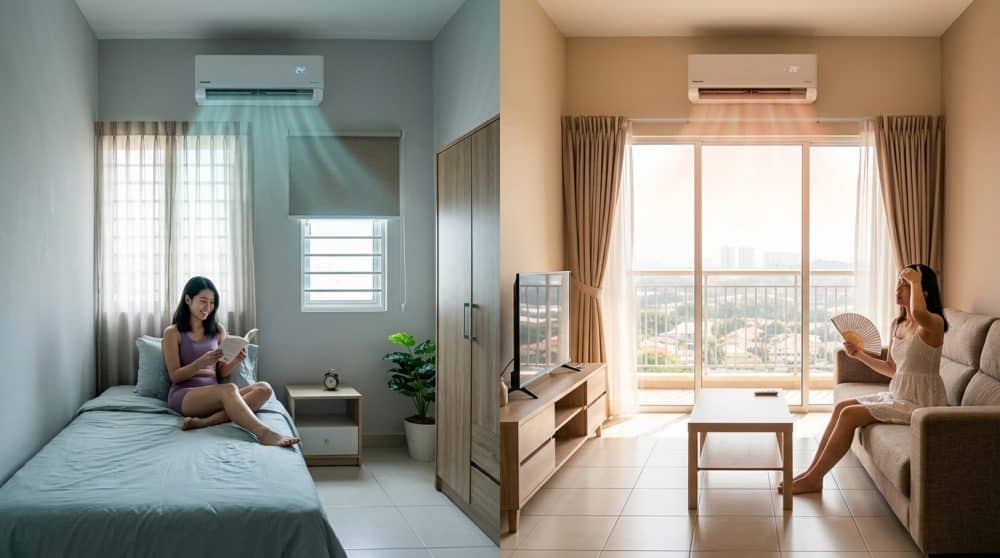
Too Small (Undersized)
An undersized aircon will run at full blast all day trying to reach your set temperature, but it will never get there. You end up with:
- A room that feels warm even though the aircon is on
- Higher electricity bills because the unit runs nonstop (see our guide to aircon electricity costs in Malaysia for the actual numbers)
- Faster wear and tear, leading to breakdowns
- If the unit is constantly overworked, it may start leaking or making noise
Too Big (Oversized)
An oversized unit cools the room too quickly and then shuts off. A few minutes later, the temperature creeps up and the unit kicks in again. This “short cycling” causes:
- Poor dehumidification. The aircon does not run long enough to pull moisture from the air, so the room feels cold but clammy and damp
- Wasted electricity from frequent on-off cycling
- More strain on the compressor
Both problems lead to the same place: higher bills and a shorter aircon lifespan. Getting the right size from the start saves you money.
Room-by-Room Guide for a Typical Malaysian Home
Here is a practical breakdown for common house layouts in Malaysia:
Terrace House (2-Storey, 20 × 70 ft)
| Room | Typical Size | Recommended HP | Notes |
|---|---|---|---|
| Master bedroom | 180 – 220 sq ft | 1.5 HP | Go 2.0 HP if top floor with poor roof insulation |
| Second bedroom | 120 – 150 sq ft | 1.0 HP | Standard choice for most families |
| Third bedroom | 100 – 130 sq ft | 1.0 HP | |
| Living room | 250 – 350 sq ft | 2.0 – 2.5 HP | Depends on whether it is open to dining area |
Condo / Apartment (800 – 1,200 sq ft)
| Room | Typical Size | Recommended HP | Notes |
|---|---|---|---|
| Master bedroom | 150 – 200 sq ft | 1.5 HP | Add one size if floor-to-ceiling glass |
| Second bedroom | 100 – 150 sq ft | 1.0 HP | |
| Living + dining | 300 – 450 sq ft | 2.0 – 2.5 HP | Consider 2 units for L-shaped layouts |
Semi-D / Bungalow
| Room | Typical Size | Recommended HP | Notes |
|---|---|---|---|
| Master bedroom | 250 – 350 sq ft | 2.0 – 2.5 HP | Corner rooms with multiple sun-exposed walls need more |
| Living room | 400 – 600 sq ft | 2.5 – 3.0 HP | Consider a ceiling cassette for better air distribution |
If you are moving into a new home and planning your aircon installation, the right HP choice goes hand in hand with the installation itself. An experienced installer will do a site assessment and confirm the HP before you buy.
Does the Type of Aircon Matter?
Yes. The most common types in Malaysian homes are:
Wall-mounted split units are the standard choice for bedrooms and smaller rooms. They are the most affordable option and come in sizes from 1.0 HP to 3.0 HP.
Ceiling cassette units distribute air more evenly across a larger area, making them better suited for living rooms and open-plan spaces (350 sq ft and above). They are pricier to buy and install, but the difference in cooling comfort is noticeable for bigger rooms.
If you are deciding between unit types, or wondering about things like 3-phase wiring requirements for running multiple aircons, it is worth talking to an installer before committing.
Also keep in mind that the type of refrigerant gas your aircon uses matters too. Newer R32 units are more efficient and environmentally friendly than older R22 systems. If your existing aircon still runs on R22, it might be time to consider a replacement.
Still Not Sure? Get a Professional Assessment
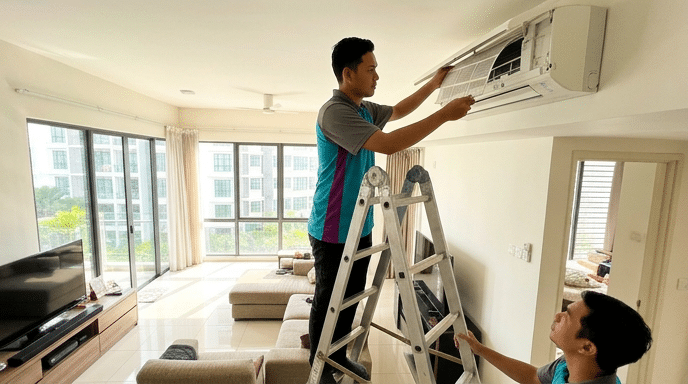
If you have an unusual room layout, very high ceilings, or you are planning aircon for your entire home, a site survey by a qualified technician is always the best way to confirm your sizing. They can account for details that a formula cannot.
On Recommend.my, you can request a quote for aircon installation and our verified pros will assess your space before recommending the right unit.
We have served over 24,700 customers for aircon services, with an overall rating of 4.6 out of 5 stars from close to 4,000 reviews.
Here is what some recent customers had to say:
Asraf in Jenjarom, Jan 2026 ⭐⭐⭐⭐⭐
“Very cheerful and full of smiles contractor. Mr Helmy explained in detail about the work as per request, troubleshoot correctly on the issue. The whole relocation process was smooth.”


