


Last week my TNB bill jumped by RM300. And when i thought about what I used more often last month, my aircon was the first suspect.
Of course, there are many other energy-guzzling appliances in my home. But most of them are running all the time, like the fridge and wifi. So any spike in energy bills can only come from (a) sudden increase in usage, or (b) something has gone wrong in one of the appliances.
And when the usage spikes, air-conditioning is one of the biggest electricity consumers in a Malaysian home. But exactly how much does it cost to run your aircon per hour? And how much is it adding to your monthly bill?
We did the math using the latest TNB tariff rates so you don’t have to.
Table of Contents
Understanding the New TNB Tariff Structure (Effective July 2025)
Before we get into the aircon numbers, let’s quickly cover how your electricity is charged now.
Since 1 July 2025, TNB restructured how your bill is calculated under Regulatory Period 4 (RP4). Instead of the old 5-tier pricing system, your bill is now made up of five components:
| Component | Rate |
|---|---|
| Energy (Generation) charge | 27.03 sen/kWh (for the first 1,500 kWh/month) |
| Capacity charge | 4.55 sen/kWh |
| Network charge | 12.85 sen/kWh |
| Retail charge | RM10/month (waived if you use 600 kWh or less) |
| Automatic Fuel Adjustment (AFA) | Changes monthly (March 2026: -2.15 sen/kWh rebate; waived if you use 600 kWh or less) |
Sources: TNB official tariff page, SoyaCincau RP4 explainer, paultan.org tariff calculation breakdown
For most Malaysian households using up to 1,500 kWh per month, your effective energy rate is about 44.43 sen per kWh (that’s the energy + capacity + network charges combined).
If your total monthly usage is 600 kWh or below, you get a good deal: the RM10 retail charge and the AFA are both waived, so you only pay that 44.43 sen/kWh rate.
If you use more than 600 kWh, the retail charge and AFA kick in. And if you go above 1,500 kWh, the energy charge jumps to 37.03 sen/kWh, making the effective rate 54.43 sen/kWh before AFA.
There’s also an Energy Efficiency Incentive (Insentif Cekap Tenaga) for households using less than 1,000 kWh per month, which gives a sliding-scale rebate of up to 25 sen/kWh. The less you use, the bigger the rebate.
For the calculations below, we’ll use the base rate of 44 sen/kWh as a round number. Your actual cost may be slightly lower (thanks to the AFA rebate and efficiency incentive) or higher (if you’re a heavy user above 1,500 kWh/month).
How Much Electricity Does Each Aircon Size Use?
The amount of electricity your aircon uses depends mainly on its horsepower (HP) and whether it’s an inverter or non-inverter unit.
Every aircon has a rated input power (in Watts) printed on its spec sheet or energy label. This tells you the maximum power it draws from the wall when running at full capacity.
Here are the typical rated power consumption figures for common aircon sizes in Malaysia:
| Aircon Size | Non-Inverter (Rated Watts) | Inverter (Rated Watts) |
|---|---|---|
| 1.0 HP | ~860W | ~750W |
| 1.5 HP | ~1,200W | ~1,000W |
| 2.0 HP | ~1,835W | ~1,500W |
| 2.5 HP | ~2,400W | ~1,900W |
Wattage figures are based on typical rated input power across popular brands in Malaysia. Sources: Sifu Engineering (1.0 HP non-inverter at ~860W), Recommend.my inverter article (2.0 HP non-inverter Daikin at 1,835W), Daikin FTV-P specs via TechRakyat (1.0 HP non-inverter at 865W). Actual wattage varies by brand and model — always check the energy label on your specific unit.
Important note about inverter aircons: The wattage above is the maximum rated power. In practice, inverter aircons adjust their compressor speed based on room temperature, so they don’t run at full power all the time. Once the room reaches the desired temperature, the compressor slows down and uses much less electricity. Real-world average consumption for an inverter unit is typically 30% to 40% lower than a comparable non-inverter unit. Daikin states their inverter technology consumes approximately 30% less energy than non-inverter models, while independent comparisons put the range at 30% to 40% depending on usage patterns and unit size. Some high-efficiency 5-star models can save up to 50% in optimal conditions.
Non-inverter units, on the other hand, run at full power whenever the compressor is on. They cycle on and off to maintain temperature, which means they consistently draw close to the rated wattage during operation. Read more about why inverter aircons are more energy-efficient.
Cost Per Hour to Run Your Aircon
Using the effective TNB rate of 44 sen/kWh, here’s what each aircon size costs per hour:
| Aircon Size | Non-Inverter Cost/Hour | Inverter Cost/Hour (est. average) |
|---|---|---|
| 1.0 HP | ~38 sen | ~25 sen |
| 1.5 HP | ~53 sen | ~35 sen |
| 2.0 HP | ~81 sen | ~55 sen |
| 2.5 HP | ~106 sen | ~70 sen |
The inverter estimates above factor in typical real-world usage where the compressor throttles down after the room is cool, not just the rated maximum.
Monthly Aircon Electricity Cost (Based on 8 Hours per Day)
Most people in Malaysia run their aircon for about 8 hours a day, usually at night for sleeping. Here’s the estimated monthly cost based on that usage pattern:
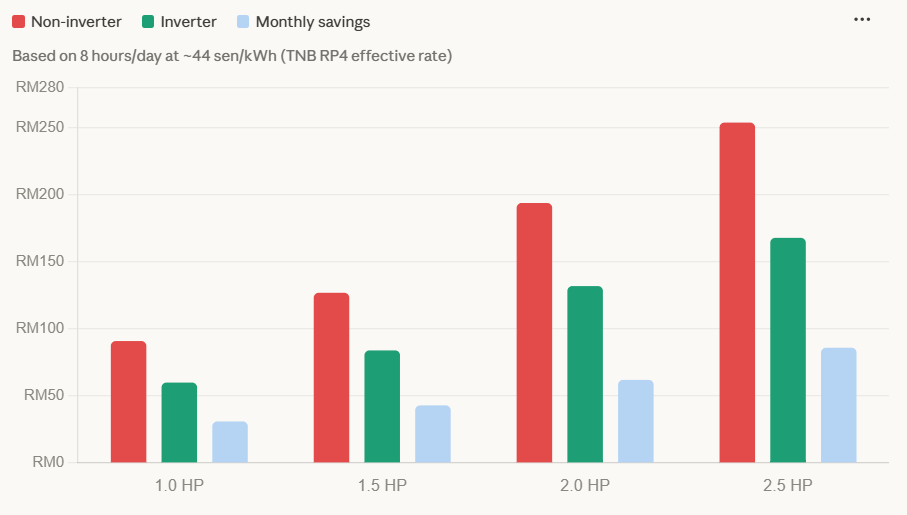
| Aircon Size | Non-Inverter (Monthly) | Inverter (Monthly) | Savings with Inverter |
|---|---|---|---|
| 1.0 HP | ~RM91 | ~RM60 | ~RM31/month |
| 1.5 HP | ~RM127 | ~RM84 | ~RM43/month |
| 2.0 HP | ~RM194 | ~RM132 | ~RM62/month |
| 2.5 HP | ~RM254 | ~RM168 | ~RM86/month |
Calculation: Rated watts ÷ 1000 × hours per day × 30 days × RM0.44/kWh. Inverter figures estimated at ~65% of non-inverter consumption on average.
If you run your aircon for 12 hours a day (for example, working from home and sleeping with it on), multiply these numbers by 1.5. A 1.5 HP non-inverter running 12 hours daily would cost roughly RM190 per month just for that one unit.
And if you have multiple units running at the same time (say, one in the master bedroom and one in a kid’s room), your aircon electricity cost adds up fast. Two 1.0 HP non-inverter units at 8 hours each would be about RM182/month.
How Your Aircon Pushes You Into Higher Tariff Brackets
Here’s something that many people don’t realise. Your aircon doesn’t just add its own cost to your bill. It can also push your total household usage past important thresholds that make everything more expensive.
The 600 kWh threshold: If your total household usage stays at or below 600 kWh, you avoid both the RM10 retail charge and the AFA charge entirely. But a single 1.5 HP non-inverter aircon running 8 hours a day already uses about 288 kWh on its own. Add your fridge (around 150 kWh), lights, washing machine, TV, and other appliances, and you’ll likely cross 600 kWh.
The 1,000 kWh threshold: Households below 1,000 kWh enjoy the Energy Efficiency Incentive rebate. Again, running two aircon units can easily push you past this.
The 1,500 kWh threshold: Cross this and your energy charge jumps from 27.03 sen/kWh to 37.03 sen/kWh. That’s a 37% increase in the energy component alone.
So it pays to be mindful of your total consumption, not just the aircon’s share.
What Affects Your Aircon’s Actual Electricity Use?
The numbers above are estimates. Your actual electricity consumption will vary based on several factors:
Temperature setting. Setting your aircon to 16°C forces it to work at maximum power for longer. At 24°C to 26°C, the compressor reaches the target faster and (for inverter units) can throttle down sooner. Every degree lower costs you roughly 3% to 5% more in electricity.
Room size and insulation. If your room is too large for the aircon’s HP rating, the unit will struggle to cool it and run at full power constantly. That’s why choosing the right HP for your room size matters.
How well-maintained your aircon is. A dirty aircon with clogged filters and grimy coils has to work harder to cool the same room. This wastes electricity and shortens the unit’s lifespan. Keeping up with regular servicing makes a real difference to your power bill. If your aircon is not cold like it used to be, that’s a sign it’s overworking and using more power than necessary.
Sun exposure. Rooms that face west and receive afternoon sun will heat up faster, making your aircon work harder.
Aircon age and condition. Older units (especially those still running on R22 gas) tend to be less efficient than newer models with R410A or R32 refrigerant.
5 Practical Ways to Lower Your Aircon’s Electricity Cost
You don’t need to sweat it out to save money. These tips can noticeably cut your aircon’s contribution to your TNB bill:
1. Set your temperature to 24°C to 26°C. This is the sweet spot for comfort and efficiency in Malaysia’s climate. Your aircon won’t have to work as hard, and combined with a ceiling fan, 25°C feels perfectly comfortable.
2. Use the timer or sleep mode. Most aircon remotes have a timer function. Set it to turn off after 3 to 4 hours of sleep. By then, the room is cool enough that a fan can take over for the rest of the night.
3. Service your aircon regularly. A clean aircon runs more efficiently and cools better. If it’s been more than 6 months since your last service, a general cleaning or chemical wash can restore cooling performance and reduce your power consumption.
4. Close doors and windows. This sounds obvious, but even a slightly open door can let warm air into the room, forcing your aircon to work harder.
5. Consider upgrading to an inverter unit. If your aircon is old and non-inverter, upgrading to an inverter model can save you 30% or more on electricity for that unit. The higher upfront cost is usually recovered within 1 to 2 years through energy savings. Read our comparison of inverter vs non-inverter aircons to see the numbers.
For more tips on reducing your overall electricity usage, check out our guide on how to create an energy-efficient home.

A Dirty Aircon Costs You More Than Just Servicing Fees
When your aircon filters and coils are clogged with dust and grime, airflow is restricted. The unit has to run longer and harder to cool your room, which means higher electricity consumption.
How much more? It’s hard to put an exact number on it, but industry estimates suggest a poorly maintained aircon can use 15% to 25% more electricity than a well-maintained one. On a 1.5 HP unit running 8 hours a day, that’s an extra RM19 to RM32 per month in wasted electricity.
Compare that to the cost of an aircon servicing at Recommend.my:
| Service Type | Wall Unit (1 unit) | Wall Unit (4+ units) |
|---|---|---|
| General cleaning | RM120/unit | RM80/unit |
| Chemical cleaning | RM150/unit | RM115/unit |
So a RM115 to RM150 chemical cleaning could save you RM20 to RM30 per month on electricity. The servicing pays for itself within 2 months, and you get cleaner air and better cooling as a bonus.
What Our Customers Say
We’ve served over 24,000 aircon servicing customers across Malaysia, with an average rating of 4.6 out of 5 from nearly 4,000 reviews.
Here’s what recent customers had to say:
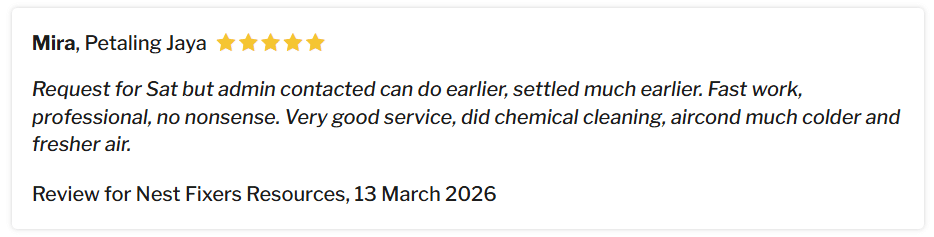
Edrick, Setia Alam — “Arrived on time, fast response and communication. Their work was clean and speedy. Recommended.” Review for Fly Force Sdn Bhd, March 2026
Ready to Get Your Aircon Serviced?
A clean aircon doesn’t just cool better. It uses less electricity, too. If it’s been a while since your last service, now’s a good time to book one.
Our verified technicians serve KL, Selangor, Johor, Penang and other major locations. You get fast booking confirmation, transparent pricing, and a 30-day service warranty.
Find top-rated aircon pros near you:
- Aircon service pros in Kuala Lumpur
- Aircon service pros in Selangor
- Aircon service pros in Johor
- Aircon service pros in Penang